Drifters
Novel instruments and methodologies have also risen from the research laboratory's activity. The occupation of a member of the Physical and Chemical Oceanography group with Lagrangian measurements in the context of the Eurofloat project in 1995, led to building expertise in this field.
Early CODE-type drifters using cellular telephony
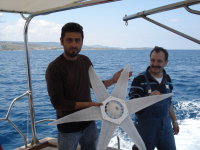
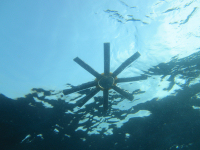
The full GSM coverage of the Aegean Sea in the early 2000s led to the design and development of novel surface (CODE-type) and subsurface drifters in collaboration with MARAC Electronics S.A. in the framework of the research project TELEFOS.
COSTA oil-spill drifters
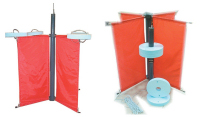
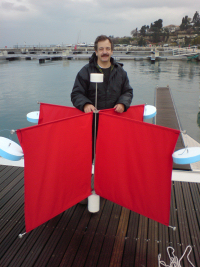
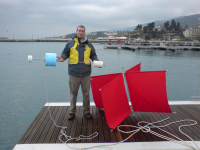
The prospect of an oil-pipeline connecting the Black-Sea harbor of Burgas with the Aegean harbor of Alexandroupolis led to a demand for a drifter especially designed to track oil-spills, assigned to our group within the project DIAVLOS. This demand was met by our design of a fully novel drifter, at the time named COSTA (from Coastal Oil Spill Tracking Apparatus, fig. 1). This drifter was later slightly modified by ΤΕΙ Piraeus specially regarding its electronics, and distributed to the partners of the European research project TOSCA for evaluation in the field, leading to very positive results.
Continuous development of CODE-type drifters
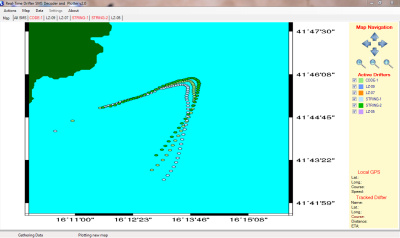
The intensifying demand for drifters has led our research group to the combination of a modified drifter hull with off-the-shelf electronics devices and new software for monitoring the drifters.
Upper-ocean shear measurement with drifter and ADCP
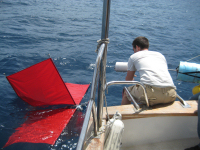
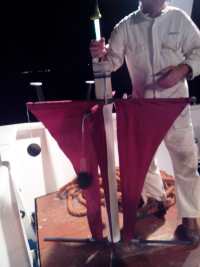
In parallel to the above activity, our group developed a new method for assessing drifter slippage, the upper 2 m water column shear and wave statistics, through the combination of a subsurface drifter and a high-resolution acoustic Doppler profiler Nortek Aquadopp HR. This method provided observations which led to the demand for drifters equipped with drogue sails of a new geometry, specially designed for comparisons with HF radars.
STRING drifters for HF-radar evaluation
This new design is currently under evaluation, funded by the bilateral Greek-French research project STRING, and may have the potential to be adopted by HF radar manufacturing companies and users globally.
Software
A Software product, tracking drifters from different types and manufacturers, developed by our research associate Alkiviadis Kalampokis, has emerged from the above research work. The latest development is the Android version of the software, which provides extreme agility and ease of use of the base station for drifter monitoring and recovering from a boat.